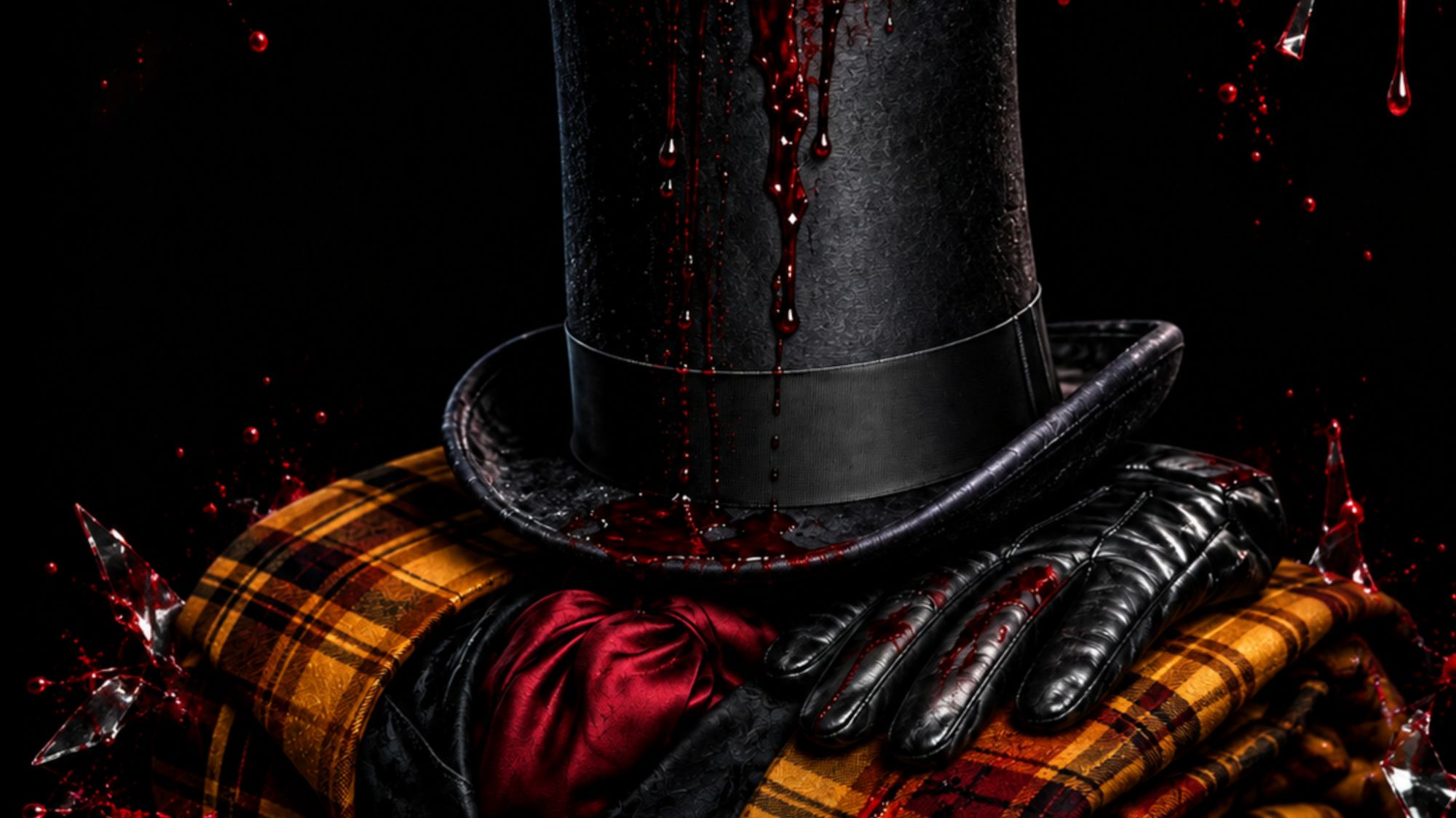
I DECLARE YOU INSANE

INTRODUCING IMMORTALIS
Immortalis is an absurd love letter to extreme horror, dark romance, eldritch terror, steampunk, Gothic grimdark and the most grotesque excesses of human depravity, all wrapped in unholy comedy, obscene erotica and a spectacular disregard for decency.
Allyra Cavidini D is the final Immoless of the century, a formidable monster slayer with a sex addiction, a questionable relationship with alcohol, considerable experience of torture and an alarming willingness to earmark members of her own family for contractual sacrifice. Resourceful, ruthless and thoroughly determined to survive, she exploits the ludicrous bureaucracy of Irkalla, Hell itself, to force the Immortalis, the very monsters destined to destroy her, into protecting her while she attempts to overturn the supernatural order and prevent her own extinction.
Unfortunately, the contract contains a particularly unpleasant condition. Throughout her quest, Allyra must reside under the protection of Nicolas DeSilva at Corax Asylum, an ancient, festering monument to institutional cruelty, supernatural madness and the depraved imagination of its Master. The arrangement delights Nicolas, whose enthusiasm for acquiring a resident female Immoless is surpassed only by that of the 215 other versions of himself inhabiting the asylum.
CORAX ASYLUM: THE ROTTING HEART OF TOGADUINE
Corax Asylum is no sanctuary. Behind its imposing Gothic architecture lies a sprawling, decaying labyrinth of damp stone corridors, rotting chambers, subterranean crypts, operating theatres and corrective facilities whose equipment has been perfected through centuries of enthusiastic experimentation. Its walls conceal the accumulated filth of innumerable atrocities, while its chambers accommodate surgical instruments, mechanical torture devices, restraints, cages and contraptions whose intended purpose becomes horrifyingly apparent once the victim has been secured. The institution is Nicolas’s private playground, a place where his every appetite can be indulged beneath the respectable pretence of medical treatment, correction, scientific advancement or recreational entertainment.
The asylum’s architecture reflects the depravity of its inhabitants. Its long corridors of one-sided cells accommodate captives whose confinement is administered with grotesque bureaucratic precision, while the sealed south wing conceals further dimensions of an institution whose history is written in suffering. Beneath the asylum, the crypt and its supernatural mirror preserve mysteries of their own, while the banqueting chambers, library, chapel and theatre provide a veneer of civilisation over an establishment devoted to the systematic degradation of its unfortunate residents. Even the most respectable surroundings serve the interests of creatures who consider cruelty a professional accomplishment and torture a perfectly legitimate recreational pursuit.
Among Corax’s most unfortunate inhabitants are the tributes, compulsory mortal sacrifices acquired and bred to satisfy the feeding requirements and sexual appetites of the Immortalis. Their existence is fundamental to the institution, demonstrating that its horrors are neither occasional excesses nor unfortunate consequences of Nicolas’s romantic obsession. Long before Allyra arrives, Corax has operated as a system of organised exploitation in which human beings are reduced to possessions, resources and disposable instruments of gratification.
The tributes inhabit a world where captivity is routine, suffering is institutionalised and the continuation of mortal life depends upon the appetites of supernatural masters. Their exploitation is administered through an elaborate parody of civilised procedure, supported by regulations, contracts and professional specialisations that transform atrocities into ordinary institutional business. Within Corax, the machinery of cruelty requires neither exceptional circumstances nor personal animosity. It is simply how the establishment operates, and its administrators take considerable pride in maintaining standards.
Yet the true horror of Corax lies not merely in its instruments, its captives or the centuries of suffering embedded within its walls. It lies in the creatures who inhabit it. Corax is the Nicolai hive, a vast, interconnected domain occupied by 216 manifestations of the same monstrous consciousness, each pursuing its own interests while remaining part of Nicolas DeSilva. The asylum is their home, their laboratory, their theatre, their hunting ground and the physical expression of their collective insanity.
Its corridors crawl with Nicolai, its chambers conceal their competing obsessions, and its darkest recesses accommodate experiments and entertainments that even their own counterparts might consider excessive. The hive possesses the extraordinary advantage of being simultaneously a household, a professional institution and an organised collective of supernatural predators. Whatever depravity one Nicolai conceives, another possesses the expertise to accomplish, a third can provide the necessary equipment and several more will volunteer to supervise.
For Allyra, contractual residence within this institution amounts to compulsory imprisonment in a rotting hive of supernatural predators, all of whom are delighted by her arrival and convinced that their enthusiasm constitutes a perfectly adequate substitute for her consent.
NICOLAS DESILVA AND THE NICOLAI HIVE
Nicolas DeSilva is the Vero, the principal self around whom the Nicolai exist, while his 215 other manifestations represent the extraordinary fragmentation of a single Immortalis. Each possesses distinctive characteristics, interests, abilities and professional specialisations, yet all belong to one shared existence. Collectively, they are manipulative, possessive, competitive, spectacularly dysfunctional and catastrophically lonely. Having an Immoless contractually obliged to reside within their domain represents, in their collective estimation, the greatest administrative achievement in recorded history.
In a particularly unfortunate departure from the conventions of dark romance, Allyra does not become involved with the brooding, handsome and regal anti-hero, Theaten. Instead, she finds herself trapped under the protection of his nasty, filthy, spoiled and sadistic younger brother, a creature whose extraordinary intelligence and supernatural power are accompanied by a temperament that would disgrace a rabid sewer rat.
Nicolas has never experienced a meaningful interaction with a woman that did not involve some degree of coercion, manipulation or catastrophic misunderstanding. The few women he has attempted to court rejected him and subsequently suffered bizarre, entirely unrelated accidents. Some apparently taxidermied themselves, while others somehow managed to fall onto a rake beneath a possessed levitating cow. Nicolas considers these incidents regrettable coincidences and refuses to entertain the possibility that his behaviour contributed to their untimely demise.
His social circle consists almost entirely of his own fractured manifestations, his long-suffering butler Chives and his psychotic brother Kane, the Evro of Theaten. Consequently, Nicolas possesses an almost entirely theoretical understanding of hygiene, personal boundaries, acceptable social behaviour and the finer points of courtship. His knowledge of torture, intimidation, psychological manipulation and the creative application of medical instruments, however, is encyclopaedic.
To Nicolas, every conversation with Allyra provides further evidence of her overwhelming romantic attachment to him. Her insults are interpreted as flirtation, her threats as expressions of passion and her attempts to escape as elaborate demonstrations of feminine coyness. His delusions are enthusiastically reinforced by the Nicolai, who have developed their own competing interests in their involuntary houseguest and regard her resistance as a minor administrative obstacle.
The situation becomes considerably more disturbing when Allyra discovers that Chester, her boyfriend of five years, is himself one of the Nicolai. More significantly, Chester is Nicolas’s Evro, his primal self, and therefore an inseparable aspect of the very monster whose protection she has been forced to accept. The revelation destroys the distinction Allyra believed existed between the man she loved and the creature who now controls her circumstances, transforming an already intolerable arrangement into a horrifying recognition that her intimate relationship has been entangled with the monstrous household of Corax all along.
BLOOD, CONTRACTS AND THE BUSINESS OF SURVIVAL
Allyra has no intention of becoming another exhibit in Theaten’s museum of preserved Immoless skulls. Her ambition is to become the first female Immortalis through blood acquisition and battle, thereby overturning the supernatural hierarchy that has condemned her to destruction. Her quest requires her to navigate the treacherous politics of the Immortalis, survive the conditions imposed by Irkalla and acquire the power necessary to challenge beings whose existence places them beyond conventional mortal resistance.
The quest also presents an extraordinary opportunity for Nicolas. Although Immortalis cannot steal one another’s blood directly, they can acquire it through a mortal vessel. Nicolas immediately recognises the possibilities of this arrangement, particularly when combined with his contractual obligation to protect Allyra and his determination to retain permanent access to the woman who has captured his interest.
He concludes that effective protection requires constant supervision, unrestricted access and the permanent presence of at least one manifestation of himself within an offensively intimate distance of his charge. He consequently appoints himself a full-time stalking little dirt goblin, following Allyra through corridors, appearing without warning, intruding upon private conversations and treating every attempt to establish boundaries as a personal affront.
The Nicolai enthusiastically participate in this arrangement, quarrelling over escort duties, opportunities for rescue, surveillance responsibilities and the increasingly contentious question of which manifestation should enjoy Allyra’s company. Their competition produces an escalating succession of jealous disputes, grotesque misunderstandings, territorial arguments and elaborate schemes, all conducted within the confines of an asylum whose inhabitants possess virtually unlimited resources and no meaningful external supervision.
Meanwhile, Nicolas attempts to impress Allyra with an extravagant programme of entertainment, including circuses, theatrical productions, banquets, zoological attractions and public spectacles that invariably deteriorate into violence, mass slaughter, supernatural absurdity or some particularly offensive combination of all three. Every event provides an opportunity for Nicolas to demonstrate his wealth, authority, theatrical imagination and complete inability to distinguish romantic generosity from an atrocity committed for the amusement of an audience.
Corax itself becomes an extension of his increasingly deranged courtship. Its theatres, banqueting chambers, corridors and places of confinement are transformed into settings for elaborate romantic gestures whose consequences range from the ludicrous to the unspeakable. The Nicolai’s professional specialisations ensure that almost every conceivable form of entertainment, punishment or medical intervention can be arranged without leaving the premises. Nicolas possesses an entire institution devoted to fulfilling his wishes, and the distinction between a romantic surprise and a compulsory medical procedure is frequently determined by the availability of surgical personnel.
Completely detached from reality, Nicolas eventually convinces himself that he and Allyra are engaged. Repeated assurances to the contrary from Allyra and virtually everyone around him merely reinforce his conviction that others are jealous of their extraordinary romance. His certainty becomes increasingly dangerous as his fantasies of marriage, domestic happiness and permanent possession begin to displace any remaining recognition of Allyra’s independence.
THE ROTTEN HEART OF THE ROMANCE
As Allyra’s quest progresses, the possibility of escaping the influence of Corax Asylum becomes increasingly important. Her ambitions extend far beyond Nicolas’s suffocating protection, and her determination to secure her own future remains fundamentally incompatible with his conviction that she belongs within his household. Nicolas, meanwhile, has constructed an elaborate romantic fantasy in which every act of defiance, every rejection and every attempt to establish independence confirms the depth of their supposed attachment.
The prospect of Allyra eventually leaving Corax threatens the entire foundation of his imagined relationship. His extravagant displays of affection, grotesque generosity and absurdly possessive behaviour conceal a far more disturbing conviction that the woman he desires is his to retain. The Nicolai, whose competing personalities have supplied much of the narrative’s grotesque comedy, share in this obsession while pursuing their own contradictory interests, jealousies and ambitions.
Their extraordinary capacity for cooperation, manipulation and collective action transforms Corax into an increasingly suffocating environment. The asylum has always possessed the means to confine, punish and control its inhabitants, but Nicolas’s growing desperation threatens to turn its institutional machinery towards the woman whose protection he has sworn to guarantee. The same creatures who compete to entertain Allyra possess the expertise to imprison her, and the instruments that have supplied centuries of suffering to Corax’s tributes remain available to a Master whose understanding of love has never included the possibility of refusal.
The horror develops through the gradual exposure of what has existed beneath the comedy from the beginning. Nicolas’s apparent eccentricities are inseparable from his appetite for domination, while the Nicolai’s ridiculous disputes conceal the frightening implications of their shared consciousness and collective power. Their elaborate performances of affection exist within an institution built upon captivity, exploitation and the systematic infliction of suffering. The romance has never been separate from the asylum’s depravity. It has merely provided another opportunity for that depravity to express itself.
As the narrative progresses, the conventions of dark romance and horror’s hurt/comfort tradition are subjected to increasingly grotesque distortions. Protection becomes indistinguishable from imprisonment, affection from possession and medical care from punishment. The absurdity intensifies alongside the cruelty, allowing the reader to recognise the monstrous implications of behaviour that initially appeared ridiculous. Every romantic gesture carries the possibility of coercion, every expression of devotion conceals an expectation of obedience, and every elaborate justification exposes the extraordinary lengths to which Nicolas will go to satisfy himself.
The comedy does not disappear as the horror intensifies. It becomes more obscene, more vicious and increasingly inseparable from the suffering it accompanies. The Nicolai retain their grotesque personalities, their intellectual pretensions, their petty rivalries and their spectacular vulgarity, but the consequences of their collective behaviour become progressively more appalling. Their ability to transform cruelty into entertainment, punishment into professional duty and captivity into an expression of affection reveals the full depravity of the world they inhabit.
What begins as a grotesque parody of romantic fiction ultimately becomes a sustained confrontation with the nature of monstrous desire, supernatural identity and absolute possession. The asylum’s accumulated centuries of cruelty, its elaborate systems of control and the extraordinary ingenuity of its inhabitants establish the conditions for an increasingly extreme descent into psychological and physical horror.
Nicolas has never ceased to be a monster, and Corax Asylum has never ceased to be a place of captivity, exploitation and suffering. The apparent transformation lies in the gradual revelation of what was present from the beginning, as the conventions of romance are stripped away to expose the grotesque reality beneath.
Immortalis is extreme horror disguised as grotesque romance, obscene comedy and supernatural farce, a sprawling descent into the depraved psychology of a multi-bodied monster whose interpretation of love becomes indistinguishable from absolute possession. It is deliberately offensive, relentlessly excessive and profoundly unpleasant, culminating in a grotesque confrontation with the full horror of Nicolas DeSilva and the Nicolai hive.

The ImmortalisVerse


From Dusk till Dawn (1996)
Salma Hayek as Santanico on stage.
No choreographer. Just that music and that snake. She was actually terrified of em. Tarantino and Rodriguez told her that Madonna would do it if she didn’t 🤣. Thank heavens Salma agreed.
Young men's lives were


Nicolas instructed the Nicolai to practise the mortal expression known as smiling, to put Allyra at ease. It did not have the anticipated effect.
Immortalis
Extreme Horror | Dark Fantasy | Absurd (Sick) Humour | Dark Romance
Bat shit from start to finish.
#fantasybooktok